Gene Bilbrew
(b. 29 June 1923 - d. May 1974)
Below illistration of man at drafting desk is considered a self portriat.
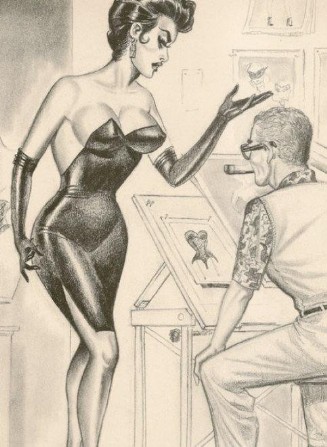
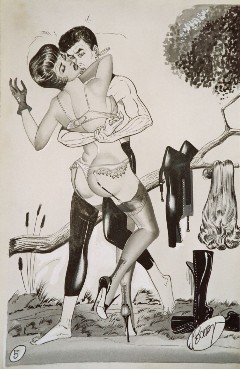
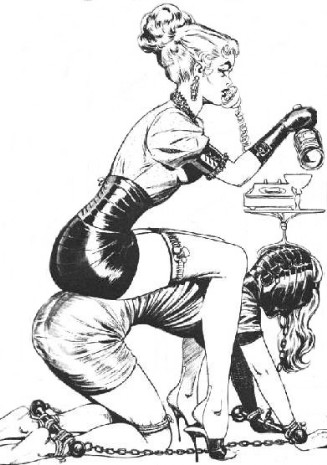
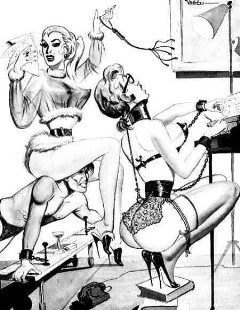
Eugene
"Gene" Bilbrew was
an African-American vocal group singer, cartoonist, and "bizarre art"
pioneer. As noted in the biography, GENE BILBREW REVEALED: The Unsung
Legacy of a Fetish Art Pioneer, he was "the first black career fetish
artist in history." Starting in the mid-1950s, he was among the most
prolific illustrators of fetish-oriented pulp book covers. In addition to
signing his work under his own name, he produced art under a range of
pseudonyms, including ENEG ("Gene" spelled backward), Van
Rod, and Bondy.
Starting in 1950, Bilbrew switched from singing to illustrative
art. Rumors that he illustrated or produced the storyline for a comic strip series named The Bronze Bomber have
been debunked, nor is there any evidence that he contributed to the
African-American newspaper, Los Angeles Sentinel. His first
professional art job was for the hugely influential comics artist Will Eisner, on The Spirit, where Bilbrew took over the back-up
series Clifford—a little-kid humor page—after its originator Jules Feiffer was drafted into the army.
Bilbrew's Clifford was syndicated as a weekly comic strip
by General Features from 1951 to 1952.
The start of Bilbrew's "bizarre art" career came in
1951 through underground artist and pioneer Eric Stanton, whom Bilbrew met while attending Cartoonists
and Illustrators School. From then on, Bilbrew focused on fetish art,
producing work for notable underground publishers Irving Klaw, Edward Mishkin, Stanley Malkin, and the
Sturman brothers. He also notably produced many illustrations and covers for
Leonard Burtman, publisher of Exotique, a fetish magazine published between 1955 and 1959.
While his career waned with
the coming of relaxed censorship laws of the 1960s, his substance abuse
worsened in the early 1970s. According to Eric Stanton, Gene Bilbrew died in the back of a Times Square adult bookstore in May 1974.